
In the modern infrastructure and energy sectors, the safe, efficient, and environmentally secure transport of petroleum products is paramount. As the Sultanate of Oman continues to expand its industrial footprint and upgrade its fueling infrastructure, the shift from traditional steel underground piping to advanced polymer solutions has accelerated.
Cochin Steel Oman, based in Airport Heights, Muscat, is the leading HDPE (High-Density Polyethylene) Fuel Piping Manufacturer and Contracting Company in the region. We provide end-to-end, turnkey solutions—from the supply of premium-grade, UL-listed HDPE pipes to the precision engineering and electrofusion installation of complex underground fuel networks. Whether you are constructing a commercial retail fuel station, an aviation fueling facility, or an industrial backup power grid in Sohar, Duqm, or Salalah, our HDPE piping systems guarantee a zero-leak, corrosion-free future.
High-Density Polyethylene (HDPE) fuel piping is a specialized, multi-layered engineered thermoplastic designed specifically for the subterranean transport of hydrocarbons, including diesel, petrol, aviation fuel, and biofuels.
Unlike traditional metallic pipes that are highly susceptible to rust, galvanic corrosion, and ground-shift stress, HDPE fuel pipes are manufactured with a specialized barrier layer (often EVOH - Ethylene Vinyl Alcohol) that prevents the permeation of volatile organic compounds (VOCs) into the surrounding soil. This makes them the ultimate environmentally safe choice for underground fuel transit.
The harsh environmental conditions of the Middle East—characterized by high soil salinity, fluctuating water tables, and extreme temperatures—are notoriously aggressive toward traditional steel pipes. Cochin Steel Oman champions HDPE fuel piping for several critical engineering advantages:
HDPE is inherently inert to aggressive soil conditions, moisture, and the corrosive chemicals found in modern fuel blends. It does not require cathodic protection or anti-corrosion tape wrapping, eliminating the primary cause of underground fuel line failure and soil contamination.
Our contracting teams utilize advanced Electrofusion Welding technology. This process uses a specialized electrical current to melt and fuse the pipe and fittings together at the molecular level. The result is a seamless, monolithic piping system where the joints are actually stronger than the pipe itself, guaranteeing a 100% leak-proof network.
Oman’s terrain can be challenging. HDPE pipes are highly flexible and can bend to accommodate trench contours without the need for numerous elbows and fittings. Furthermore, this flexibility allows the piping system to absorb ground movements, thermal expansion, and vehicular vibrations (dynamic loads) from heavy trucks at fuel stations without cracking or fracturing.
The exceptionally smooth internal bore of our HDPE pipes prevents the buildup of scale and reduces fluid friction. This ensures highly efficient fuel flow rates from the underground storage tank (UST) to the fuel dispenser, minimizing the strain on submersible turbine pumps (STPs).
A properly installed HDPE fuel piping system boasts a design life exceeding 50 years. By eliminating the risks of corrosion and joint failure, facility owners benefit from drastically reduced maintenance costs and absolute peace of mind.
As a dual-capability Manufacturer and Contracting Company, Cochin Steel Oman takes complete ownership of your fuel piping project, ensuring uninterrupted quality control from material selection to final commissioning.
We supply high-performance, double-wall (secondary containment) and single-wall HDPE fuel pipes that comply strictly with international standards, including UL 971 (Standard for Nonmetallic Underground Piping for Flammable Liquids) and EN 14125. Our pipes are engineered to handle all petroleum-based products safely.
Our Muscat-based team of certified pipe fitters and electrofusion technicians handles the complete mechanical installation of your fuel network. Our contracting services include:
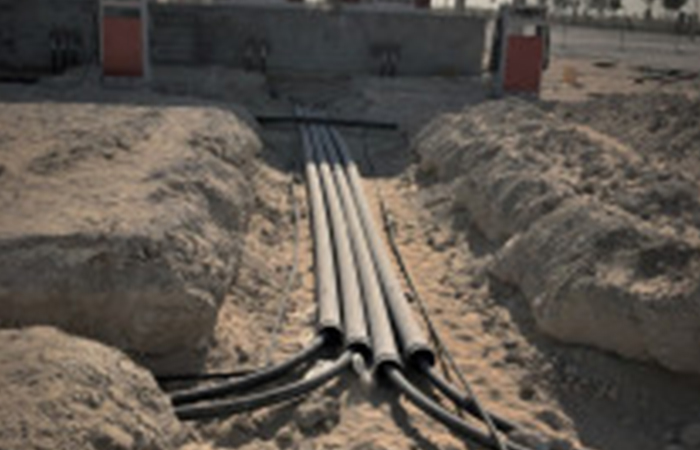
• Trenching and Bedding: Proper excavation and sand bedding to ensure the structural integrity of the underground pipes.
• Precision Electrofusion: Executing flawless molecular welds using calibrated, state-of-the-art electrofusion machines.
• Sump and Dispenser Connections: Installing watertight entry boots and connecting the piping seamlessly to tank sumps, transition sumps, and under-dispenser containment (UDC) sumps.
For environmentally sensitive areas or strict regulatory zones, we install double-wall HDPE piping. This system features an inner primary pipe for fuel transport and an outer secondary pipe that acts as a containment jacket. This allows for continuous interstitial leak detection, ensuring that even if the primary pipe is compromised, no fuel reaches the Omani soil.
Before burying any fuel line, our quality assurance team conducts rigorous pressure testing (pneumatic testing) in accordance with Oman Civil Defence and MoCIIP regulations. We ensure every joint is verified, delivering a fully certified, operational system ready for fuel dispensing.
Our engineered HDPE piping solutions are the critical arteries for various high-stakes industries across Oman:
• Retail Petrol Stations: Comprehensive underground piping networks connecting storage tanks to forecourt fuel dispensers for brands across the Sultanate.
• Industrial & Manufacturing Facilities: Dedicated diesel lines feeding high-capacity backup generators, boilers, and industrial furnaces in key economic zones like Sohar Industrial Estate.
• Aviation & Marine: Safe, high-volume fuel transport lines for airport ground support equipment and marine bunkering facilities.
• Data Centers & Telecommunications: Providing ultra-reliable diesel piping to emergency standby power systems, ensuring zero downtime for critical IT infrastructure.
• Mining and Quarrying: Heavy-duty, abrasion-resistant fuel lines capable of surviving the rugged environments of Oman’s mining sectors.
Operating out of Airport Heights, Muscat, we possess a deep understanding of Omani terrain, local environmental regulations, and the strict safety protocols required by the Royal Oman Police (ROP) - Directorate General of Civil Defence.
Electrofusion is a highly specialized skill. Our technicians undergo rigorous training and certification processes to ensure that every weld is executed perfectly, regardless of site conditions.
Because Cochin Steel Oman is also the premier manufacturer of Underground and Aboveground Steel Fuel Storage Tanks, we offer unparalleled integration. By sourcing both your tanks and your HDPE piping from a single contractor, you eliminate compatibility issues, streamline project management, and drastically reduce construction timelines.
Yes. Our specialized HDPE fuel pipes feature a permeation barrier (such as EVOH) that makes them perfectly safe and compatible with diesel, unleaded petrol, kerosene, aviation fuel, and modern bio-fuel blends.
Absolutely. We supply and install piping that is UL 971 approved and fully compliant with the safety and environmental standards mandated by the Oman Civil Defence and local municipalities.
Single-wall pipes have one layer of containment. Double-wall pipes feature an outer "jacket" over the primary pipe. If the inner pipe leaks, the fuel is contained within the outer jacket, and an electronic sensor will trigger an alarm. Double-wall piping provides maximum environmental protection.
Yes. We specialize in fuel system upgrades and retrofitting. Our contracting team can safely decommission and remove old, corroded steel lines and replace them with a modern, leak-proof HDPE network with minimal disruption to your operations.
Because HDPE is flexible, lightweight, and joined via rapid electrofusion, installation is significantly faster than welding, threading, and wrapping traditional steel pipes. Exact timelines depend on the site's scope, but it typically reduces piping schedules by up to 50%.
Yes. We supply a complete ecosystem of components, including electrofusion elbows, tees, reducers, entry boots, tank sumps, and under-dispenser containment (UDC) units to ensure a fully integrated, watertight system.
When the safety of your facility and the surrounding environment is on the line, you cannot afford to compromise on your underground fuel piping. Partner with Cochin Steel Oman to guarantee a flawless, corrosion-free, and legally compliant installation.
• Head Office: Airport Heights, Muscat, Sultanate of Oman (P.O. Box 3818, PC 111)
• Phone: +968 9951 1615
• Email: sales@cochinsteeloman.com
• Website: www.cochinsteeloman.com
Cochin Steel Oman—Engineering the arteries of Oman’s energy infrastructure with precision, safety, and uncompromising quality.
Operating from our strategic base in the Sultanate of Oman, we serve all major national regions, including Muscat, Sohar, Salalah, Duqm, Sur, and Nizwa. Beyond Oman, we have established a strong global footprint through the successful export and installation of storage tanks, silos, and fabrication solutions across: The GCC & Middle East: United Arab Emirates (Dubai, Abu Dhabi, Sharjah, Ras Al Khaimah, Ajman, Umm Al Quwain, Al Ain, Fujairah), Saudi Arabia (Riyadh, Jeddah, Dammam, Mecca, Medina, Khobar, Jubail, Yanbu, Tabuk, Hail), Kuwait, Qatar, Bahrain, Syria, Iraq, Libya, and Yemen. Africa: Egypt, Sudan, Ethiopia, Somalia, Nigeria, Democratic Republic of Congo, Djibouti, Eritrea, Kenya, Ghana, Tunisia, Morocco, Tanzania, and Uganda. Asia: The Maldives and other emerging industrial markets.