
Cochin Steel Oman is a leading manufacturer and supplier of plate forming services in the Sultanate of Oman, delivering high-precision, structurally engineered, and industrial-grade fabrication solutions for oil & gas, petrochemical, power, marine, and construction industries. Strategically located in Airport Heights, Muscat, we bring over 18 years of engineering excellence from the Cochin Steel Group, supporting fabrication and EPC projects across Muscat, Sohar, Salalah, Duqm, and the wider GCC region.
Plate forming is a core capability in modern fabrication, enabling flat metal plates to be transformed into complex shapes required for tanks, pressure vessels, pipelines, and structural components. In Oman’s industrial ecosystem, where fabrication quality directly impacts safety and performance, precision plate forming is a non-negotiable requirement.
Plate forming is a metal fabrication process that reshapes flat steel or metal plates into desired geometries using mechanical force without removing material. It relies on plastic deformation, allowing the metal to change shape while maintaining its mass and structural integrity .
This process typically involves:
Sheet and plate forming reshapes metal using forces such as tension and compression to achieve required shapes without cutting or removing material .
Plate forming is widely used to produce cylindrical, conical, and curved components essential for industrial applications.
Plate forming is a foundational process in fabrication industries. Without it, the manufacturing of pressure vessels, storage tanks, pipelines, and structural components would not be feasible.
Plate forming is essential for converting raw steel plates into usable components for engineering and infrastructure projects .
Cochin Steel Oman offers a comprehensive range of plate forming techniques tailored to different industrial requirements.
Plate rolling is one of the most widely used forming processes.
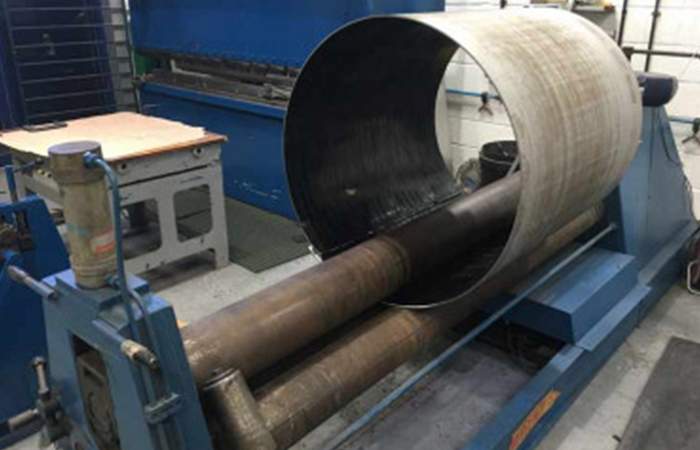
Plate rolling involves bending metal plates using rollers to form cylindrical or curved shapes .
Bending processes use dies and press brakes to shape metal into required angles and profiles .
At Cochin Steel Oman, plate forming is executed using advanced machinery and precision-controlled processes.
These capabilities ensure:
Plate forming requires significant mechanical force and specialized equipment to achieve permanent deformation without compromising material integrity .
Plate forming is based on plastic deformation of metal.
Forming reshapes metal by applying mechanical forces such as compression and tension without removing material .
This ensures that:
Ensures accurate shaping for complex components.
Maintains strength and durability of materials.
Suitable for a wide range of shapes and applications.
Minimizes material wastage and production costs.
Supports both small and large-scale production.
Integrates seamlessly with welding and fabrication processes.
Plate forming is widely used across multiple industries:
Plate forming is a key process in fabrication, enabling the production of structural and industrial components across sectors .
Plate forming offers several advantages over alternative manufacturing methods:
Compared to machining, forming retains material integrity and reduces production costs.
Cochin Steel Oman follows strict quality control procedures to ensure high standards:
These tests ensure compliance with project specifications and international standards.
All plate forming services comply with international standards and local regulations.
These standards ensure:
Cochin Steel Oman provides fully customized plate forming solutions tailored to project requirements.
Each component is engineered based on application requirements and environmental conditions.
Plate forming is integrated with complete fabrication services:
This ensures seamless production of finished components ready for installation.
From our Muscat facility, Cochin Steel Oman supplies plate forming solutions across:
We ensure efficient logistics, consistent quality, and timely delivery.
Over 18 years of expertise in fabrication and plate forming.
State-of-the-art forming and fabrication equipment.
Tailored solutions for diverse industrial applications.
Strict adherence to international standards.
From design to delivery and integration.
It is used to shape metal plates into components like tanks, vessels, and structures.
Oil & gas, construction, marine, power, and petrochemical industries.
Yes, depending on equipment and process.
Yes, it minimizes material waste and reduces production costs.
Yes, including forming, welding, and assembly.
Cochin Steel Oman is a trusted leader in plate forming services in Oman, delivering precision-engineered, high-quality, and industry-compliant fabrication solutions. With advanced technology, strict quality control, and a commitment to excellence, we provide components that ensure structural integrity, operational efficiency, and long-term performance.
COCHIN STEEL OMAN
Airport Heights, Muscat, Sultanate of Oman
P.O. Box 3818, PC 111
+968 9951 1615
sales@cochinsteeloman.com
www.cochinsteeloman.com
Operating from our strategic base in the Sultanate of Oman, we serve all major national regions, including Muscat, Sohar, Salalah, Duqm, Sur, and Nizwa. Beyond Oman, we have established a strong global footprint through the successful export and installation of storage tanks, silos, and fabrication solutions across: The GCC & Middle East: United Arab Emirates (Dubai, Abu Dhabi, Sharjah, Ras Al Khaimah, Ajman, Umm Al Quwain, Al Ain, Fujairah), Saudi Arabia (Riyadh, Jeddah, Dammam, Mecca, Medina, Khobar, Jubail, Yanbu, Tabuk, Hail), Kuwait, Qatar, Bahrain, Syria, Iraq, Libya, and Yemen. Africa: Egypt, Sudan, Ethiopia, Somalia, Nigeria, Democratic Republic of Congo, Djibouti, Eritrea, Kenya, Ghana, Tunisia, Morocco, Tanzania, and Uganda. Asia: The Maldives and other emerging industrial markets.